Carrying On a U.S. President’s Legacy — as Part of the Satell Institute
As it turns its attention to preventing political violence and ensuring fair elections at home, new SI member The Carter Center — founded by President Jimmy Carter — sees a growing role for corporations and private foundations.
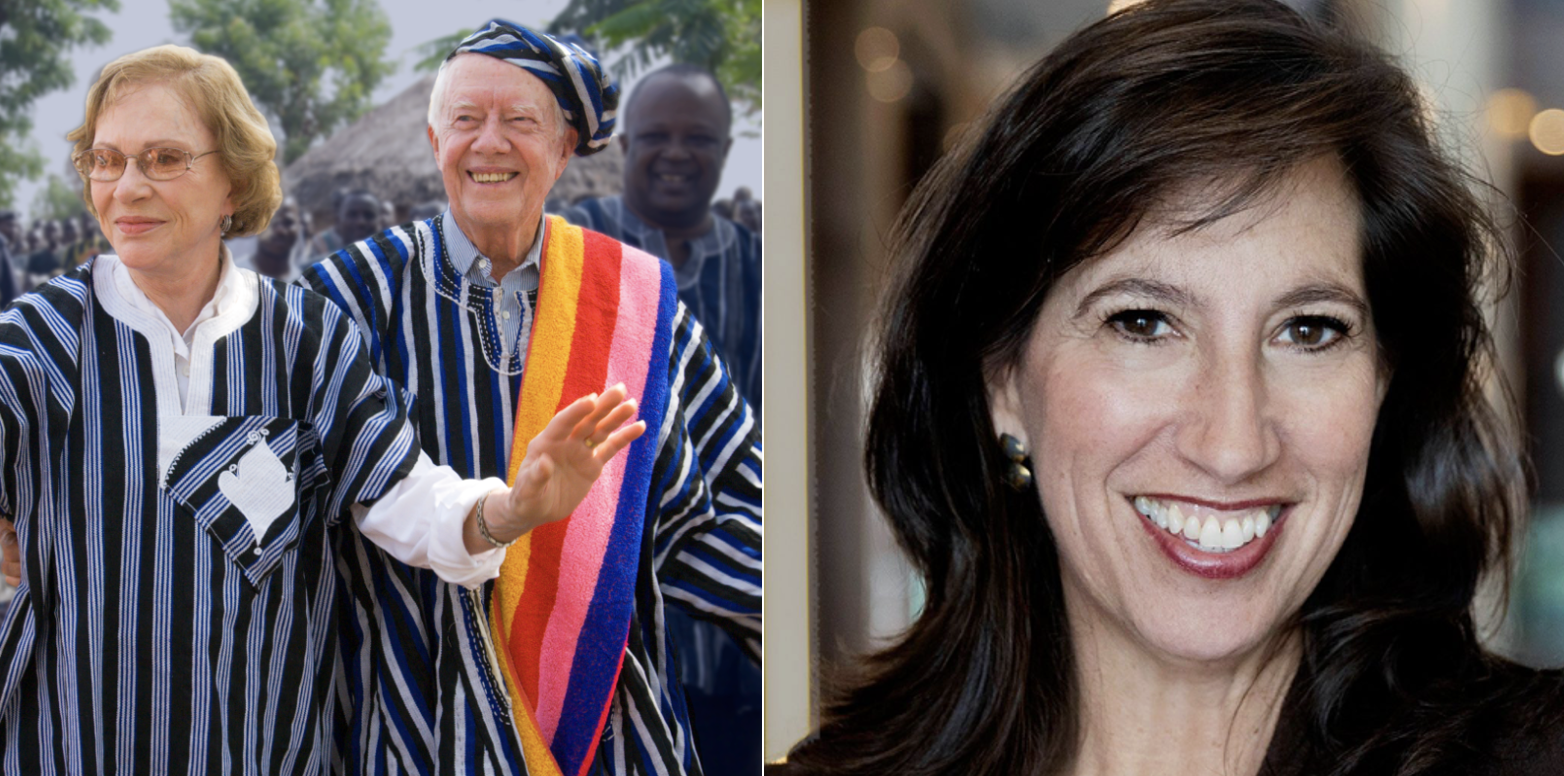
Rosalynn and Jimmy Carter (left); Carter Center CEO Paige Alexander
* * *
Jimmy Carter hardly needs an introduction. The onetime Georgia peanut farmer, who died last year at age 100, not only became the 39th President of the United States; he re-invented post-Presidential life by founding The Carter Center, which over the last four decades has worked vigorously to promote peace, democracy, and public health.
This fall, the Satell Institute was thrilled to welcome The Carter Center as a member.
In this new interview, Carter Center CEO Paige Alexander — a longtime international development leader who joined the organization in 2020 — talks about President Carter and his wife, Rosalynn; the Center’s new focus on preserving fair elections in the U.S.; the crucial role business plays in its work; and the power of the Satell Institute’s fast-growing network.
* * *
The Carter Center was founded…
… when President and Mrs. Carter were, as they liked to say, “involuntarily retired” from the White House. They decided to establish The Carter Center in conjunction with their library and museum. The idea was to create something here in Atlanta that would be kind of like a mini-Camp David — that would give people an opportunity to come and work on conflict resolution and human rights and the issues that were important to President Carter in his presidency.
Over the period of 40 years, President Carter began to see people who were suffering from neglected tropical diseases. He would say, “There are no neglected people. There are just neglected diseases.” So he felt like he had to address those diseases. And so suddenly, we were doing peace programs and global health. That's how we grew over the last 40 years.
When it comes to global health…
… we're working to eradicate guinea worm. That will be only the second human disease ever in history — smallpox being the first — that has been eradicated. And it will be the only disease eradicated without a vaccine — it's all about how to collect water differently. When we started, there were three-and-a-half million cases a year in 21 countries. We are currently down to nine human cases in three countries.
Then we work on six other diseases, such as blinding eye diseases, malaria and elephantiasis.
On the peace side…
…we've worked on peace programs in 20 different countries, resolving conflict from Sudan to Mali to various places throughout the subcontinent in Africa. And now we're starting to do some of that work domestically because we realize that the conflict resolution programs we do there are actually relevant here.
The nonprofit organizations we support through Satell are…
…the North Carolina Network for Fair, Safe and Secure Elections, and the Wisconsin Alliance for Civic Trust. As I said, drawing on our work overseas, we decided to help launch grassroots networks in multiple states to push back on the misinformation and political violence that were happening.
The key for us was to make sure the organizations are authentically local and led by respected state leaders from both the right and the left. And so in North Carolina, we have a former Republican state Supreme Court judge and a former Democratic mayor of Charlotte. Together they’re focused on an issue that we can all agree on, which is fair, safe, and secure elections.
We’ve started these “democracy resilience networks” in North Carolina, Florida, Michigan, Wisconsin, Arizona and Georgia. It gives us a chance to have those folks talk amongst themselves when political violence happens. When the elected officials were shot in Minnesota, that was information that all our democracy resilience networks leaned in on, trying to elevate the language. Same in Arizona when Charlie Kirk was killed.
We try to be the catalyst and connector. Someone sharing these lessons on a local level is more relevant than someone in Washington saying, this is how you should do something.
Corporate and foundation partners…
… have been core to our success since our founding. President Carter turned to pharmacy partnerships with Merck and Pfizer to be able to do some of the work we do for our mass drug administrations, for these blinding eye diseases in the field. The Gates Foundation is also a long-term relationship that we have had.
We want to pay it forward as we build these democracy resilience networks. We know that they need something to jumpstart them and catalyze them into doing the work.
One reason businesses have wanted to work with us…
…is that President Carter set the tone by focusing intently on efficiency and results, and that helped bring in corporate and private foundation sponsorship. You know, President Carter was very frugal in the best of ways, and he knew that if he was using somebody else's money, we had to have impact. The focus on results was something that he felt so strongly about, and I think that's why we've had these long-term relationships.
Merck has said they will provide the drugs we need for as long as we need them. And you don't get that kind of buy-in if they don't know it’s all going to a good cause.
President Carter wasn’t…
….afraid of taking risk, and he wasn't afraid of failure. That's in our mission statement. The only failure is if you haven't tried. And so we've tried a lot of different initiatives, and we've been successful at a good number of them. And where we weren't, we cut our losses.
Our first major connection to the Satell Institute…
…came back in February, when our Vice President for Peace Programs, Barbara Smith, was invited to speak at a meeting the Satell Institute held at the United Nations in New York. She came away very impressed by the commitment and energy of the members and the Satell team.
As we learned more about the Institute, we thought it's a wonderful opportunity to connect with others who share our values, and we can also learn from their experiences. So much of our work in peace and health is about leveraging the power of networks and communities. That's how change happens — and the Satell Institute is built on that same premise.
Looking ahead…
…we want to continue to grow our work in the U.S. in both protecting democracy and pushing back on political violence in a nonpartisan way.
In our global work, corporations and foundations are more important now that the U.S. government has stepped back, and it's left groups like USAID and the World Health Organization no longer able to do their activities. Are we safe and secure when we don't have that?
I don't think it's safe or secure for corporations to be in the midst of something that they don't have any control over. And so I think corporations have a dog in this fight now, and it's important that they feel that they have ways to engage. We want to learn, and we're hoping to find allies to help us solve some of these big problems.